

 Let's try this theory out for size:
The amateur draft in baseball is the most important draft in all of the major professional sports. It's more important than all the hoopla associated with the NBA and NFL drafts and it's certainly more important than the NHL draft. Sure, those other drafts get much more hype than the baseball draft simply because the casual fan has heard of all the top players, but as far as sheer impact on an organization goes, nothing has a greater effect than the baseball draft.
Let's try this theory out for size:
The amateur draft in baseball is the most important draft in all of the major professional sports. It's more important than all the hoopla associated with the NBA and NFL drafts and it's certainly more important than the NHL draft. Sure, those other drafts get much more hype than the baseball draft simply because the casual fan has heard of all the top players, but as far as sheer impact on an organization goes, nothing has a greater effect than the baseball draft.
Tomorrow the Phillies will entrust director of scouting Marti Wolever, assistant GM Mike Arbuckle and their scouts and baseball people to shape the organization for (hopefully) the next decade. Gripped with a dearth of prospects in the minor leagues, Wolever and the gang can really replenish the system during tomorrow's draft because they have seven selections in the first 136 picks.
"It's the first time in 16 years we have this many picks that I can remember," Wolever said. "It's real significant. We have a chance to impact the system by putting some quality players in."
The Phillies have to wait until the 24th overall pick on Thursday afternoon to make their first pick, but after that they come quickly. The Phillies also have the 34th, 51st, 71st, 102nd, 110th and 136th picks. The 34th selection is a compensation pick from the Giants from when they signed free agent Aaron Rowand away from the Phillies.
Nevertheless, the reason why baseball drafts are so important is because the player/prospect becomes such an integral part of the organizations' plans. Certain prospects, like Cole Hamels was, are deemed "untouchable" in things like trades or potential Rule 5 drafts. Because of that, guys like Hamels are earmarked spots in the rotation well into the future, which causes the team to act accordingly. Why would a team like the Phillies make a deal for a pitcher if they have someone like Cole Hamels down on the farm?
Additionally, baseball players spend a long time in an organization. Teams invest time, money and resources in developing ballplayers even if they aren't labeled as "prospects." After all, baseball organizations are more than just one, Major League team. Instead, they are chains of teams located all over the hemisphere that need players, coaches, trainers, scouts, etc., etc. in order to function. They are, indeed, franchises that need a lot of different moving parts.
Therefore, the players selected in the draft matter.
What's more, certain prospects not labeled as "untouchable" are perfect for helping teams over the short term. In fact, it's difficult to find significant trades in baseball that do not include prospects because every team covets them. So in order to land a player that could put a contending team over the top during the stretch run, a prospect or two might be the cost.
Before the 2000 season the Phillies thought they were a team that would be in the mix for a wild-card spot if they could get another starting pitcher to compliment Curt Schilling. In thinking veteran right-hander Andy Ashby was the pitcher they needed, the Phillies dealt away first-round draft picks Adam Eaton and Carlton Loewer to San Diego.
It was a controversial deal at the time, but with the aid of hindsight it appears as if the trade were a push. Injuries wrecked Loewer’s career, Eaton came full circle and back to the Phillies, while Schilling and Ashby were both traded away during June of 2000 when it was clear the Phillies weren’t contenders.
So yeah, a good draft pick can help out a team now or later.
On Thursday, Wolever is hoping for both. However, based on the team's drafting strategy, the down-the-road part appears to be the best analysis - at least in terms of the pick joining the Phillies. See, Wolever likes to target "high-ceiling" players, which means the Phillies often select high school players as opposed to more polished college prospects in the draft.
Still, Wolever has selected four college players with the team's first pick dating back to 2000.
"You can't take all high-ceiling players," Wolever said. "When you need to reach down into Triple and Double-A and he's still in [Single-A], that doesn't help."
At least not yet.
Regardless, the Phillies will take a big step toward shaping their future on Thursday afternoon. Tune in to hear about players you'll be talking about a lot a few years from now.
 So far, the 2008 season has bordered on
  I feel the need to amend. I'd say clarify instead, but to do something like that means to omit a wrong.
And man was I wrong.
I feel the need to amend. I'd say clarify instead, but to do something like that means to omit a wrong.
And man was I wrong. Word from Washington, D.C. is that the great Ian MacKaye famous for his work with
  Runs are easy to understand. Actually, scoring runs are the most important thing in baseball. Get more than the other team and you win. Yes, it's so simple.
The thing about runs though is that they have a way of clouding up the memory banks. It actually might be one of those cases where one cannot see the forest save for the trees.
Runs are easy to understand. Actually, scoring runs are the most important thing in baseball. Get more than the other team and you win. Yes, it's so simple.
The thing about runs though is that they have a way of clouding up the memory banks. It actually might be one of those cases where one cannot see the forest save for the trees. When Ryan Howard and Jimmy Rollins were awarded the MVP in consecutive seasons, it was hardly original. After all the fact is there were different players from the same team that won back-to-back MVP awards lots of times. Actually, it's not even all that uncommon.
But if, say, Chase Utley were to be the MVP for the 2008 season - now that would be something.
When Ryan Howard and Jimmy Rollins were awarded the MVP in consecutive seasons, it was hardly original. After all the fact is there were different players from the same team that won back-to-back MVP awards lots of times. Actually, it's not even all that uncommon.
But if, say, Chase Utley were to be the MVP for the 2008 season - now that would be something. I love trends. Just love ‘em. I love trends so much that I sometimes even take the time to figure out who is following the so-called conventional wisdom and who is not. Better yet, in my anti-establishment ethos that I have been honing since I first discovered
 More interestingly, Nationals pitching coach Randy St. Claire told Boswell that he has noticed a difference in the shape and size of the ballplayers around the league.
 I have a theory that if you need someone like Ryan Howard or Chase Utley to say something insightful to make or break your story, you are, indeed, a [bleepy] writer.
It's not a well-thought out theory or one that I've ever really tested in a controlled environment. Truth be told and based on my observations from going into the Phillies clubhouse and hanging around the team for the better part of the last nine seasons, Ryan Howard and Chase Utley are the least interesting ballplayers I have ever seen address a group of people about their profession.
I have a theory that if you need someone like Ryan Howard or Chase Utley to say something insightful to make or break your story, you are, indeed, a [bleepy] writer.
It's not a well-thought out theory or one that I've ever really tested in a controlled environment. Truth be told and based on my observations from going into the Phillies clubhouse and hanging around the team for the better part of the last nine seasons, Ryan Howard and Chase Utley are the least interesting ballplayers I have ever seen address a group of people about their profession. Actually, the better question is why does anyone care? Are insights from professional athletes so vital to the national discourse? I certainly hope not. But in the proliferation of the celebrity culture, athletes need not apply. In 2008 there is no difference between Chase Utley and Ryan Howard than there is between George Clooney and Denzel Washington. And, in an odd bit of irony, athletes are being chided for not speaking out on issues as well as for their general verbosity, while movie stars are ripped for speaking out too much.
 WASHINGTON - One of the neat things about this city is that sports really aren't all that important. Oh sure, Washingtonians love their teams - especially the Redskins - but what drives the news and the talk here is the industry.
In D.C. it's all about the government.
WASHINGTON - One of the neat things about this city is that sports really aren't all that important. Oh sure, Washingtonians love their teams - especially the Redskins - but what drives the news and the talk here is the industry.
In D.C. it's all about the government. WASHINGTON - Washington, D.C. is an industry town. And in most industry towns, the matters of business are all encompassing. Generally, the folks who work in The District are on the clock 24/7 even when Congress is not in session and the Congressmen and their staffs are back in their home districts.
Of course, this year is different. The Industry here in Washington is diving into its quadrennial pageant complete with costumes and hype and everything else that goes with the thing called a presidential election. As a result they force the rest of us to follow along, too, which is good. Who doesn't want to understand and participate in the nation's sovereignty?
WASHINGTON - Washington, D.C. is an industry town. And in most industry towns, the matters of business are all encompassing. Generally, the folks who work in The District are on the clock 24/7 even when Congress is not in session and the Congressmen and their staffs are back in their home districts.
Of course, this year is different. The Industry here in Washington is diving into its quadrennial pageant complete with costumes and hype and everything else that goes with the thing called a presidential election. As a result they force the rest of us to follow along, too, which is good. Who doesn't want to understand and participate in the nation's sovereignty? Yet a good indicator at how encompassing the industry is in D.C. was pretty evident within seconds of walking into the new Nationals Park. For instance, in the spacious visitors' clubhouse one of the half dozen or so high-definition televisions hanging from the ceiling was tuned to Chris Matthews' "Hard Ball."
 The reason Kendrick will take in the game from the bullpen is because he tossed just 12 pitches in his rain-shortened outing against the Blue Jays at the Bank yesterday. So rather than have Kendrick throw just 12 pitches in 10 days, the Phillies are going to make use of the right-hander as best as they can.
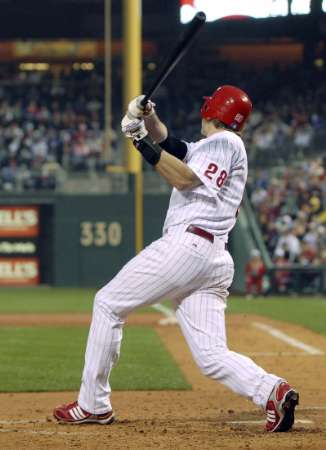 If a guy gets the chance to get out to the ballpark a lot during the course of a baseball season, chances are that guy will see some anomalies every once in a while. Sometimes it's deviant behavior like a dude (or dudette) in his underwear dashing around on the outfield grass. Other times the notable event is a cycle or a no-hitter or something that borders on the historic.
And by historic we mean how it pertains to baseball and its string of seasons.
If a guy gets the chance to get out to the ballpark a lot during the course of a baseball season, chances are that guy will see some anomalies every once in a while. Sometimes it's deviant behavior like a dude (or dudette) in his underwear dashing around on the outfield grass. Other times the notable event is a cycle or a no-hitter or something that borders on the historic.
And by historic we mean how it pertains to baseball and its string of seasons. What's that growing out of Billy Wagner's ear... oh, it's one of those pathetic bluetooth things. You know, the phone devices that make annoying folks look like they have an entire cadre of friends that may or may not be calling every five to ten minutes. Barring that, it makes it easier for the self-possessed to appear as if they are not talking to themselves.
Nevertheless, it appears as if Wagner, or "Country Time" as he has been dubbed in The City, will be talking to himself a lot these days. That's because not only was he
What's that growing out of Billy Wagner's ear... oh, it's one of those pathetic bluetooth things. You know, the phone devices that make annoying folks look like they have an entire cadre of friends that may or may not be calling every five to ten minutes. Barring that, it makes it easier for the self-possessed to appear as if they are not talking to themselves.
Nevertheless, it appears as if Wagner, or "Country Time" as he has been dubbed in The City, will be talking to himself a lot these days. That's because not only was he  At this point, writing about Ryan Howard's cluelessness at the plate or Brett Myers' mental meltdowns on the mound is nothing more than piling on. Plus, the last thing that a guy struggling through bad funk really wants to hear is more advice from a bunch of people who think they have the answer to everything.
So rather than pick at the scab of the Phillies' offense and pitching rotation with over-analysis, pretentiousness and general blathering on, we'll focus our attention on something else. But before we move on, try these out:
At this point, writing about Ryan Howard's cluelessness at the plate or Brett Myers' mental meltdowns on the mound is nothing more than piling on. Plus, the last thing that a guy struggling through bad funk really wants to hear is more advice from a bunch of people who think they have the answer to everything.
So rather than pick at the scab of the Phillies' offense and pitching rotation with over-analysis, pretentiousness and general blathering on, we'll focus our attention on something else. But before we move on, try these out: